
Are Oregon Mugshots Public?
Oregon draws a sharp line here. A booking photo is not an ordinary roster field. Under ORS 133.870, a law-enforcement agency cannot release a booking photo unless one of the statute's exceptions applies. The law defines that image narrowly: a photo taken by law enforcement for identification when a person is booked into custody. The rule binds the agency holding the image. It does not erase copies a publisher already holds.
The general right to inspect public records lives in ORS Chapter 192. ORS 133.870 carves an exception into that framework. Text fields face no such wall. A county may still post a name, booking date, custody status, charge, or release event when other laws allow the release. Court records answer to their own custodians. So do state corrections records. A page labeled an Oregon busted mugshot is not an official agency release. It should never override a court disposition.
Check the court file, not the photo. A disposition may show a dismissal, acquittal, plea, conviction, or another result entirely.
The current ORS Chapter 133 page separates booking-photo rules from general arrest provisions.
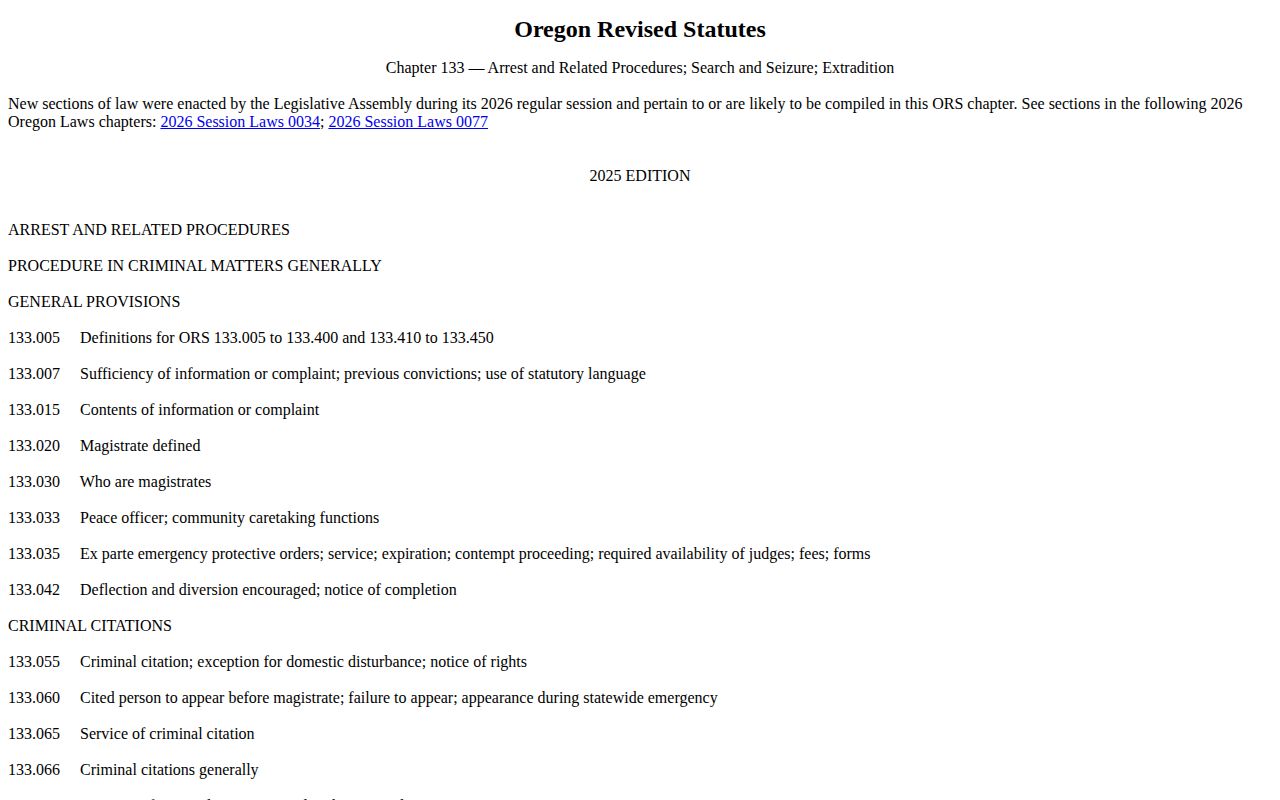
The statute runs on two separate tracks. One covers an agency's release decision, while the other covers a publisher's duty to remove a photo in limited cases.
Oregon's Booking-Photo Rule
ORS 133.870 spells out its exceptions. A photo can go to the person shown. Another law-enforcement agency or officer can receive one for law-enforcement work. Public release requires a law-enforcement purpose. The statute names examples such as finding a fugitive or suspect or identifying other criminal activity. These are narrow grounds. The rule is no broad permission to post every booking image, and the other exceptions serve a particular case, care, or identification need; they include these grouped categories.
- A state mental hospital when the person is admitted, a party to a criminal case, or a victim.
- A court confirming identity for pretrial release, or an investigator licensed under ORS 703.430 in the stated circumstances.
- Release to the public after a conviction that results from the arrest for which the photo was taken.
The exact exception matters. A news report proves little by itself. Nor does a random third-party copy. Such an image does not show that a county roster may publish the same photo today, and its source may be a court filing, an earlier authorized release, a different agency, or another jurisdiction. When you request one, identify the image and ask the custodian to state the basis for any denial or redaction. A blank photo field on a roster does not mean no booking image exists.
HB 3273 Changed Oregon Photo Access
The Legislature put these limits in place through House Bill 3273 in 2021, Oregon Laws chapter 374. The bill had two parts. One restricted law-enforcement release of booking photos. The other created removal duties for qualifying publish-for-pay publications. ORS 133.870 was amended again in 2025, so the current statute controls wherever it differs from an older bill summary or agency notice. County systems changed practice around January 1, 2022. Benton, Lane, Marion, and Multnomah, among others, kept publishing booking, custody, charge, or release data while dropping routine public photos. Timing and display vary by county. Some rosters keep a photo column or placeholder. Others offer no image field at all. The enrolled measure page records the bill's stated policy and chapter information, not a current roster policy for each sheriff.
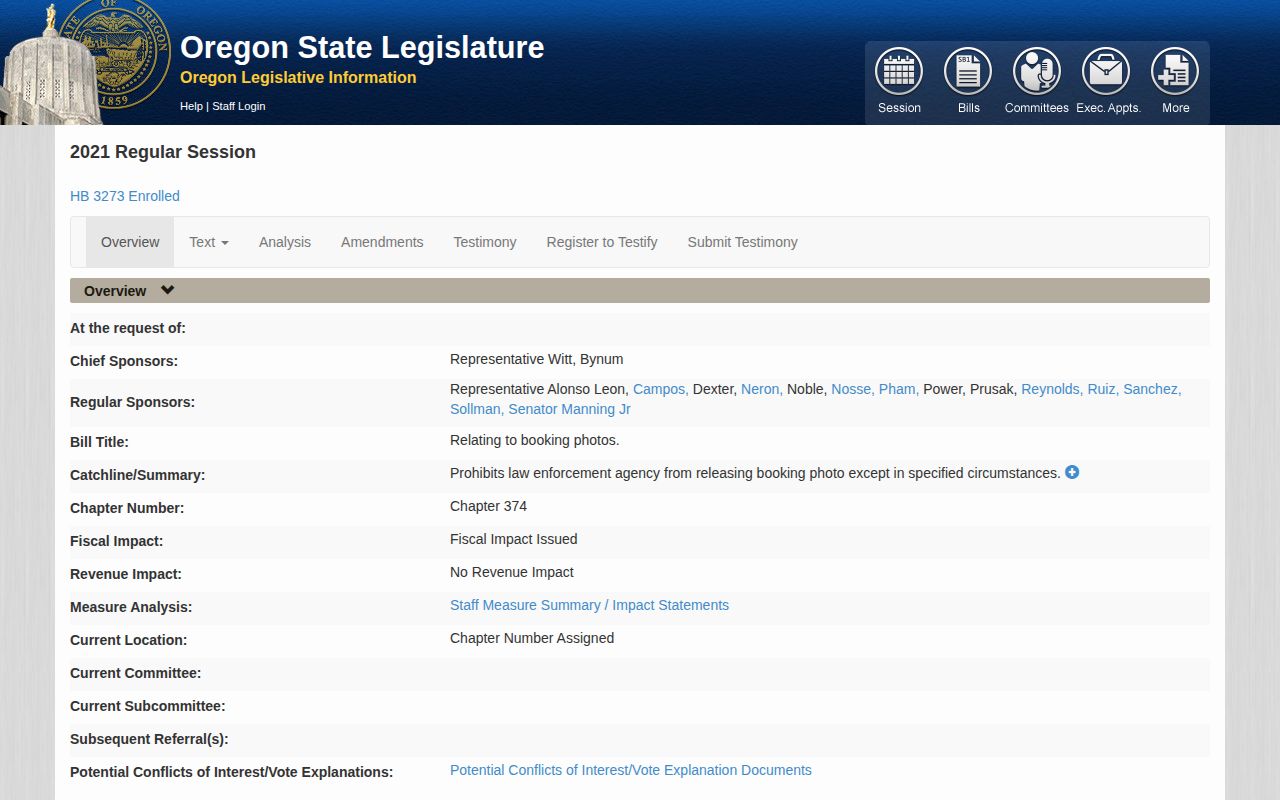
For today's photo rules, go to the agency that made the record and check its current public page.
Note: The law controls an agency's release of a booking image, while each county chooses how to present the other records it may publish.
Oregon Arrest Records After Booking
The photo rule left the rest of a booking record intact. County rosters still work. A page may list a person in custody, the alleged charge, and the booking date, with no image attached. Some agencies keep an event log or release list. Others limit the page to people currently held. That creates a blind spot. Once a person leaves jail, they drop off a live roster even though the arrest record stays with the agency. Oregon has no single statewide county booking system. A search usually starts with the county or the arresting agency. The statewide Oregon arrest and roster overview routes to county systems and explains their different photo practices.
Oregon Public Records Have Limits
ORS 192.314 gives anyone the right to inspect public records that are not exempt. ORS 192.324 covers how inspection and copies work in practice. Put any request in writing. Name the agency you are asking. Add the person or event, the record type you want, a useful time range, and the arrest or booking date if you know it. When a file mixes public and protected material, ask for the nonexempt parts that can be separated out.
The public body must acknowledge the request or finish it within the statutory framework. After that, it responds within the next required period or explains the delay with a reasonable estimate, subject to the law's exceptions. Still, a request is no shortcut around the photo law. ORS 133.870 is the specific rule for law-enforcement booking photos, and other limits can cover medical details, personal identifiers, confidential sources, juvenile information, or an active investigation. An agency may hand over a booking date and charge while withholding the image itself. When something is denied, ask the records custodian which authority applies rather than guessing.
Oregon Juvenile Arrest Records
Youth cases sit behind a privacy wall. ORS Chapter 419A and ORS 419A.255 restrict those records. Adult custody pages won't serve as a juvenile lookup. A blank result, a redacted response, or an old news snippet gives no basis to name a young person. Nor does it support repeating a claim about one. The Oregon Revised Statutes page for Chapter 419A lays out the juvenile-code framework.
Juvenile expunction runs on forms built for youth matters. Never assume adult set-aside rules fit a juvenile record. Other public-record exemptions apply record by record. A sheriff may share an arrest date while withholding a witness name, a medical detail, or an investigative lead. Legally recognized harm also justifies some withholding. A delay can mean a live case or a slow records review. Keep the exact wording of any cited exemption and ask for the portions the agency can separate.
Oregon Set-Aside Eligibility
Oregon calls adult relief a set-aside. Many people say expungement. Under ORS 137.225, the court can seal eligible arrest and criminal case records by order. The offense, outcome, sentence, and timing all count. The current OJD packet walks through the filing steps, and the full case record decides who qualifies.
| Case type in the OJD packet | General wait |
|---|---|
| Class B felony | Seven years |
| Class C felony or certain abuse/person-related contempt | Five years |
| Class A misdemeanor | Three years |
| Class B or C misdemeanor, violation, or unrelated contempt | One year |
For convictions, the waiting clock starts at conviction or release from prison. The longest applicable period controls. A new offense can stretch that wait. The sentence must be fully done, meaning probation, restitution, and fines included. No disqualifying conviction may appear during the wait. Open charges or a disqualifying case also block relief. Class A felonies, many sex offenses, child-abuse crimes, and other listed categories are excluded. Revoked probation changes the math. DUII dismissals after diversion do not qualify under the packet, and guilty-except-for-insanity cases follow different laws.
Arrests and citations that never became filed cases work differently: a person may file 60 days after the prosecutor declines charges, or any time after dismissal or acquittal. The court still must enter an order. A set-aside follows eligibility rules rather than arriving automatically with a roster update.
Note: Check the current OJD packet and ORS 137.225 before relying on a waiting period, since case details can change eligibility.
Oregon Set-Asides and Online Photos
Adult filing starts with the Oregon State Police fingerprint process where it is required. Then come the OJD motion and declaration. Serve the prosecutor in the county where charges were or could have been filed. File it in the circuit court that handles the case. The district attorney usually has 120 days to object. A signed court order proves the record is sealed. The packet covers arrests, citations, convictions, dismissals, and acquittals. A mixed case may need a motion naming only eligible charges. Keep your copy of the order and the case number, since the court creates it. OJD's adult set-aside forms page is the official starting point. It carries the current motion and instructions.
A court order seals the official record as the law allows. It cannot force private sites to act. News archives and caches may keep a photo. Federal-record questions and rare unsealing situations differ. For a current Oregon prison or community-corrections profile, the separate DOC offender search is the right tool; it is not a county booking archive.
Free Oregon Mugshot Correction Routes
ORS 133.875 targets one defined type of publisher: a publish-for-pay publication. That means a publication or website demanding payment or other consideration to remove or delete a booking photo. Send an ordinary removal request. A qualifying publication must remove and destroy the photo within 30 calendar days. It cannot condition that request on a fee above $50. Miss the deadline and the statute states costs, attorney fees, and $500 per day in damages.
A stronger route opens when the requester documents an acquittal, nonprosecution, or a conviction that was set aside, vacated, or pardoned. Then a qualifying publisher must remove and destroy the image within seven calendar days. No fee or other consideration may be required. Damages run $1,000 per day after that deadline. Charging a fee in that documented-disposition situation may be prosecuted as theft by deception. These rules do not bind every news outlet, archive, search engine, or independent copy on the web.
| Publisher route | What its published policy says |
|---|---|
| BustedNewspaper Oregon | Its free removal form asks for the post URL, contact details, a reason, and supporting documents. The publisher says it acknowledges requests on a five-to-ten-day schedule. |
| RecentlyBooked Oregon | Its policy says it charges no fee for removal, suppression, or modification. Send the page URL, name, arrest date, state/county, reason, and legal papers. Listed grounds include dismissal, set-aside or sealing, wrong person, outdated facts, juvenile matter, or duplicate. Accurate current records generally stay listed. |
| Arrests.org Oregon | No general free personal removal policy was verified. Its contact page can be used to ask for a factual correction, but it does not promise deletion. |
| Mugshots.zone | No verified Oregon state section or Oregon-specific free removal route was found in the research review. |
Sites like these are secondary sources, never official Oregon rosters. Their coverage can be spotty. A voluntary takedown policy binds only the publisher that wrote it. When you file, keep the source URL, the disposition order, and your request date. Wrong or stale entry? Name the error and attach the official record. Accurate current listings may not qualify.
Note: A publisher's own response window describes its policy; it does not replace ORS 133.875's deadlines when that statute applies.
Check an Oregon Arrest Record
Start at the source. Once a court result or correction lands, fix the page itself. Then ask a search engine to refresh it. Google's outdated-content tool works on stale search entries after the underlying page changes. It will not seal a court file or force any publisher to drop a record. Why does order matter? The source page, the court record, and the search result sit with three different entities.
- Confirm the arresting agency and ask its records unit for the releasable booking record. Request the court case number if known.
- Check the Oregon court record for the final disposition. Ask the court clerk about document access if the public search only shows an event or judgment entry.
- If a set-aside was granted, send the order to the agency and any qualifying publisher whose page remains online.
- Check whether the source page changed. Only then use an outdated-result route for a search entry that still points to the old version.
No paid service edits the court's own record. None can promise to scrub every copy of an arrest photo. Treat any claim otherwise with real doubt. Lean on the statute, the court order, and the publisher's free correction route, then confirm the change at the source.